By James Walker — CFP® candidate, Boston MA · Updated January 2026

The first time I sat down with the compound interest formula during CFP coursework, I genuinely got angry that nobody had taught it to me at 18. This single concept — understood in 10 minutes — is worth more than every personal finance book combined. Let me walk you through it with real US numbers.
What is compound interest?
Compound interest is interest earned on both your original principal and on the interest you’ve previously earned. Simple interest pays you on the principal only. Compound interest is what makes investments grow exponentially over time.
The formula:
FV = PV × (1 + r)n
- FV = Future Value
- PV = Present Value (what you start with)
- r = Annual return rate (decimal — 7% = 0.07)
- n = Number of years
Run a quick example: $10,000 at 7% for 30 years = $10,000 × (1.07)30 = $76,123. You more than 7× your money without adding a dime — just from time and compounding.
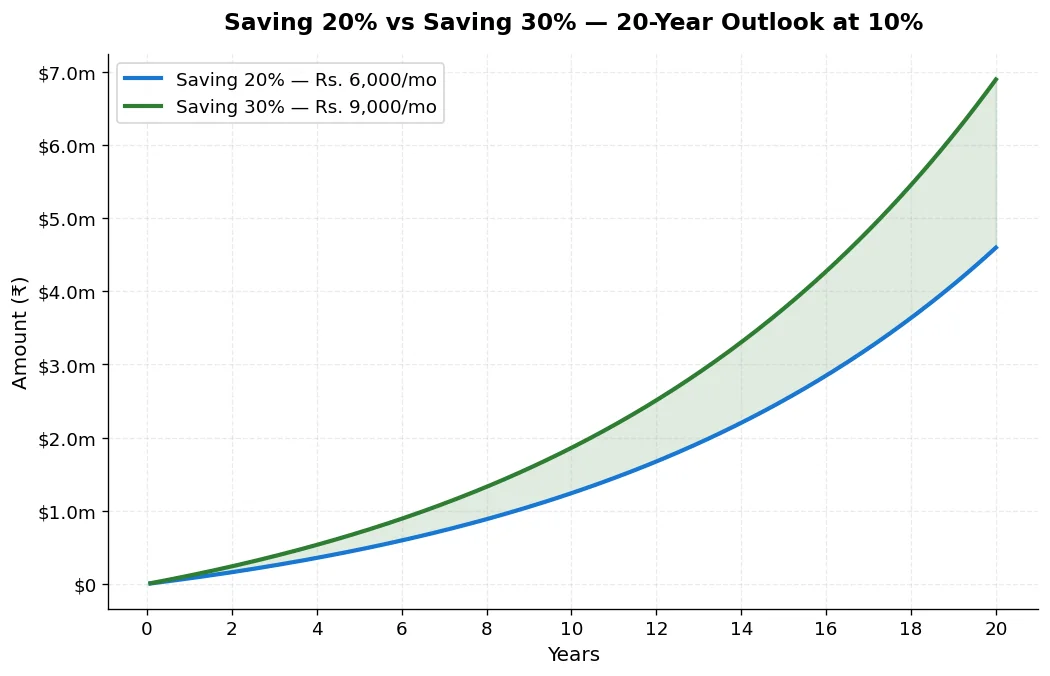
Why does starting at 25 beat starting at 35?
This is the example that changed my life. Consider two investors, both targeting age 65:
Early Eric — invests $300/month from age 25 to 35, then STOPS
- Total contributions: $36,000 over 10 years
- Then stops contributing entirely but leaves the money invested
- Balance at age 65 at 7% annual return: ~$540,000
Late Larry — invests $300/month from age 35 to 65 (full 30 years)
- Total contributions: $108,000 over 30 years
- Balance at age 65 at 7% annual return: ~$365,000
Eric contributed $72,000 less than Larry but ended up with $175,000 more. That’s the magic of starting 10 years earlier and letting the early money compound for an extra decade.
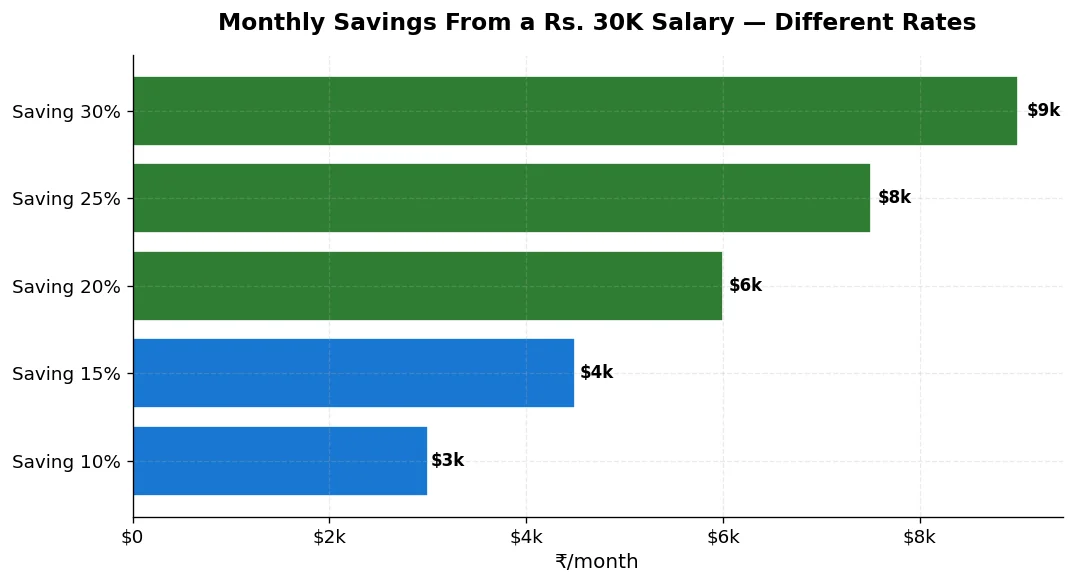
The Rule of 72 — a mental shortcut
To estimate how long it takes money to double at a given rate, divide 72 by the rate.
- At 7% return: 72 ÷ 7 = ~10.3 years to double
- At 10% return: 72 ÷ 10 = ~7.2 years to double
- At 4% return: 72 ÷ 4 = 18 years to double
At 7% (close to the long-run real return of the US stock market per Investor.gov’s compound interest calculator), your money doubles roughly every decade. Starting 10 years earlier means one extra doubling. That’s the whole magic.
What return should you actually expect?
Be honest with yourself here. TikTok finance influencers throw around 15–30% returns. Reality is much more conservative.
- S&P 500 historical nominal average: ~10% per year (1928–present, per various academic sources)
- S&P 500 historical real return after inflation: ~7% per year
- Long-term Treasury bonds: ~5–6% nominal historically
- High-yield savings account (today): 4.0–4.5% — great for cash, but you’re losing to inflation long term
- A 60/40 stock/bond portfolio: ~8% nominal, ~5% real
Returns are not guaranteed. The S&P 500 had a -37% year in 2008. It also had several +25%+ years. The average comes from staying invested through both.
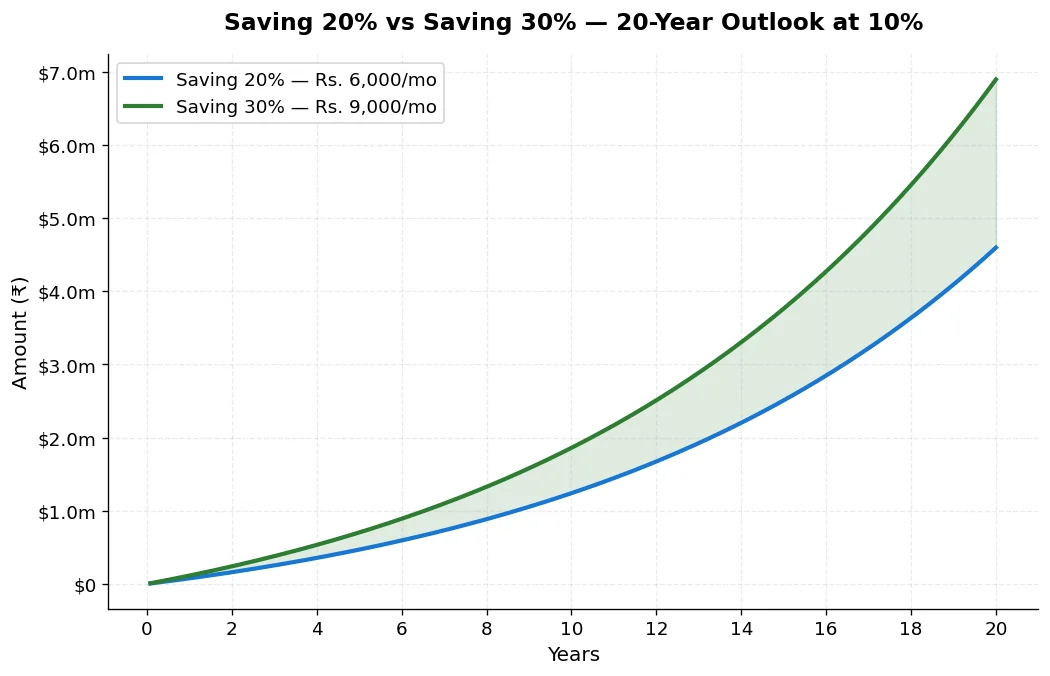
How much do you need to invest to retire?
The common rule is the “4% rule” — you can sustainably withdraw 4% of your nest egg per year in retirement (adjusted for inflation). Reverse-engineer this:
- Want $40,000/year in retirement income? You need $1,000,000
- Want $60,000/year? You need $1,500,000
- Want $80,000/year? You need $2,000,000
How much per month to get there?
- $1M by age 65 starting at 25, at 7%: ~$400/month
- $1M by age 65 starting at 35, at 7%: ~$815/month
- $1M by age 65 starting at 45, at 7%: ~$1,920/month
- $1M by age 65 starting at 55, at 7%: ~$5,800/month
Same goal, very different monthly cost depending on when you start. Time is your single biggest advantage.
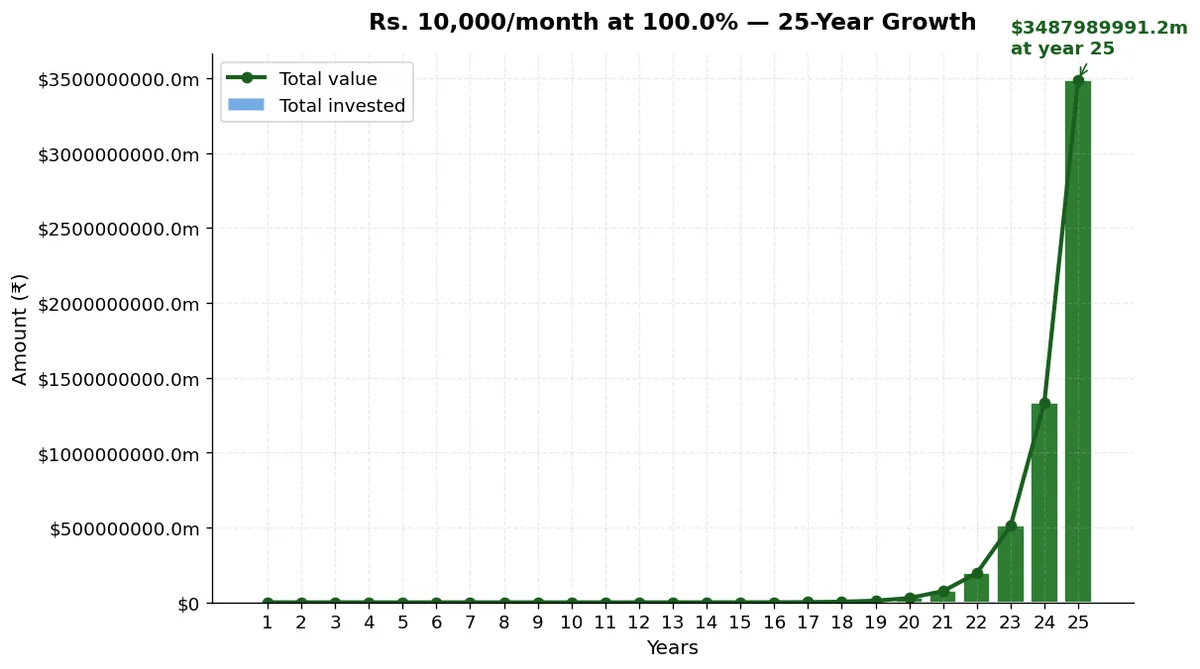
Where should you actually put the money?
Compound growth only happens inside an actually-invested account. Cash in checking compounds at ~0%. Cash in a HYSA compounds at ~4%. The stock market historically compounds at ~7% real / 10% nominal.
For most beginners, the CFP-style framework is:
- 401(k) up to the employer match (see our 401(k) match guide)
- Starter $1,000 emergency fund
- Pay off high-interest debt
- Max HSA if eligible (see HSA vs FSA)
- Max Roth IRA (see Roth vs Traditional)
- Back to the 401(k) toward the $23,500 cap
- Taxable brokerage for anything above
Within those accounts, low-cost index funds (Vanguard VTI, Fidelity FZROX, Schwab SWTSX) capture the broad market return without trying to time anything. This is an educational point — not a recommendation to buy any specific fund.
What about inflation?
Inflation is the silent compound enemy. At 3% annual inflation, $100 today has the buying power of $74 in 10 years and $55 in 20 years. This is why holding all your savings in cash is so dangerous over decades — you’re guaranteed to lose purchasing power.
“Real return” = nominal return minus inflation. A 4.5% HYSA in a 3% inflation environment is a 1.5% real return. That’s positive, but slow. The stock market’s ~7% real return is what historically builds wealth.
Common mistakes that kill compounding
- Waiting to start until you “have more money” — the time you lose is irreplaceable
- Cashing out a 401(k) when changing jobs — you pay 10% penalty + ordinary income tax and reset the compound clock
- Picking individual stocks based on TikTok tips — even pros underperform the index ~80% of the time over 15+ years
- Panic-selling in a market crash — locks in losses and misses the recovery
- High-fee actively managed funds — a 1% extra annual fee over 40 years can reduce your final balance by 25%+
Frequently Asked Questions
Is compound interest the same as compounding returns?
Functionally yes, but the language differs. “Compound interest” usually refers to savings accounts, bonds, or CDs where a fixed rate is applied periodically. “Compounding returns” refers to investments like stocks where the return varies but the principle of growth-on-growth is identical. The math (FV = PV × (1+r)n) applies to both.
How does compounding frequency affect my returns?
Compounding more often (daily vs annually) gives slightly more growth. At 5% rate over a year, $10,000 compounded annually grows to $10,500; compounded daily grows to ~$10,513. The difference is small at typical bank rates. For stock-market investing, you don’t pick compounding frequency — gains compound continuously as prices move.
What is negative compounding and why is it dangerous?
The same math that builds wealth also destroys it. Credit card debt at 22% APR compounds against you. A $5,000 balance at 22% with only minimum payments becomes $11,000+ over 10 years. This is why paying off high-interest debt is mathematically equivalent to a guaranteed 22% return — better than almost any investment. See our avalanche vs snowball guide.
Can I really retire with $300/month invested?
If you start at 25, invest in low-cost index funds, average 7% real return, and don’t touch it — yes, you can reach roughly $700,000 by age 65. That funds about $28,000/year of inflation-adjusted retirement spending. Not luxurious, but viable when combined with Social Security. The earlier you start, the smaller the monthly amount needed.
Should I use a compound interest calculator?
Yes — the SEC’s free Investor.gov compound interest calculator is the most trustworthy. Plug in your starting balance, monthly contribution, expected return, and time horizon to see your projected balance. Try different return assumptions (5%, 7%, 9%) to see how sensitive the result is — this is humbling and useful.
