By James Walker — CFP® candidate, Boston MA · Updated January 2026

$50,000 is roughly the US household median, and yet most middle-income workers tell me they “cannot afford” to save for retirement. The math says otherwise. As I work through retirement planning case studies for CFP, the $50K-salary worker who starts at 25 and saves 10-15% retires with seven-figure wealth. Here is the actual plan.
What is my real take-home on $50K?
Single filer, $50K gross, standard deduction ($14,600), no state tax (TX, FL): federal income tax around $4,016, FICA $3,825. Net: roughly $42,160/year or $3,513/month. In Massachusetts (5% state): federal $4,016, FICA $3,825, state $1,770. Net: roughly $40,389/year or $3,366/month.
How much should I save for retirement?
Traditional CFP guidance: 15% of gross income toward retirement. At $50K that is $7,500/year – or $625/month. Most middle-income workers find this aggressive on take-home of $3,400/month. A more realistic glide path:
- Years 1-2: capture full employer match (often 3% = $1,500)
- Years 3-5: build to 10% contribution ($5,000)
- Years 6-10: push to 15% ($7,500)
- Years 11+: max contributions if possible ($23,500 in 2026)
What is the employer 401(k) match math?
Most US employers offer some 401(k) match. Common formulas: 100% match on first 3% of salary; 50% match on first 6% of salary; “Safe Harbor” 3% non-elective contribution regardless of employee contribution. Per IRS 401(k) limits, employee contributions are limited to $23,500 in 2026 ($31,000 with age-50 catch-up).
On a $50K salary with a 100%-match-up-to-3% formula: you contribute $1,500, employer contributes $1,500. That is an instant 100% return – the highest guaranteed return in personal finance. Never leave employer match on the table.
How do I split between 401(k) and Roth IRA?
The textbook prioritization for a $50K earner:
- 401(k) up to full employer match (capture free money)
- Roth IRA up to annual limit ($7,000 in 2026)
- HSA if eligible with high-deductible health plan ($4,300 self in 2026)
- Back to 401(k) up to limit ($23,500)
- Taxable brokerage for any further savings
For a $50K earner in the 12% federal bracket, the Roth IRA is especially attractive – paying tax now at 12% to avoid future tax at potentially higher rates in retirement is a strong bet.
What is the Saver’s Credit at $50K?
Per IRS Saver’s Credit, single filers with AGI up to $39,500 in 2026 qualify for a non-refundable credit of 10-50% on the first $2,000 contributed to retirement accounts. At $50K AGI you may not qualify (limits change slightly each year – verify on IRS), but contributing to a traditional 401(k) can lower your AGI into qualifying range.
What is the 30-year compounding math?
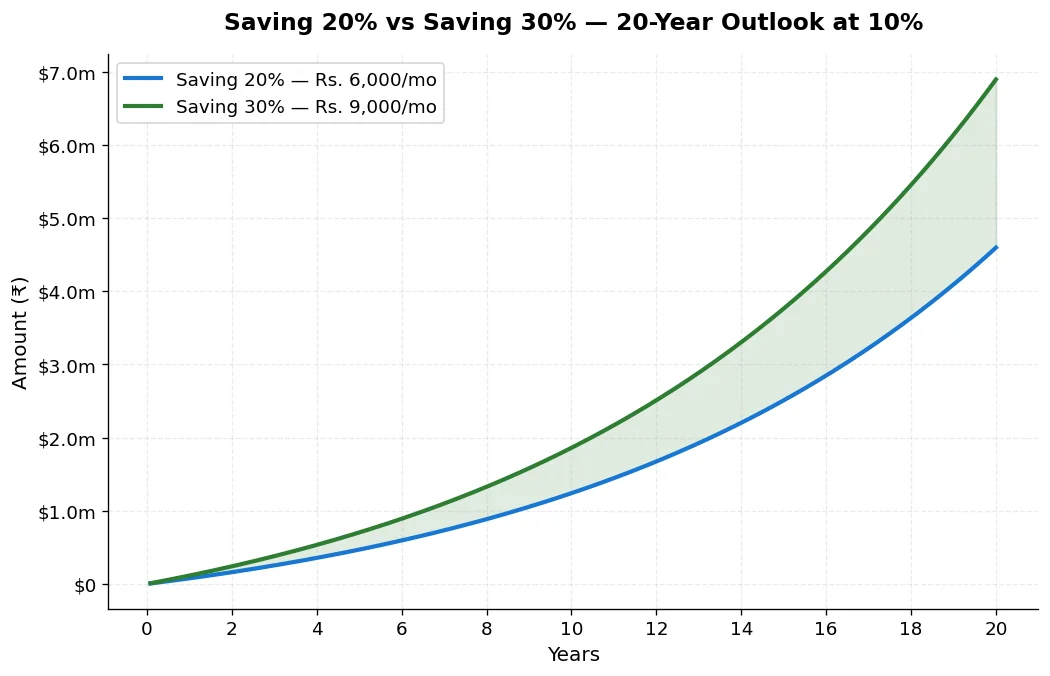
$5,000/year invested at 7% real return for 30 years grows to approximately $505,000. Add $1,500 employer match annually compounded at 7%: another $152,000. Add $200/month Roth IRA at 7%: $245,000. Total: approximately $902,000 in real (inflation-adjusted) dollars.
At 8% real return (more historically accurate for stock-heavy portfolios): the same scenario yields roughly $1.2M.
What if I am starting at 35 instead of 25?
Starting 10 years later costs roughly half of your final balance. To compensate, push contributions to 15-20% if possible, or work to 67 instead of 62. The most expensive financial decision of your life is failing to start retirement contributions in your 20s – those first 10 years of contributions account for roughly 50% of your eventual balance due to compounding.
How do I invest the contributions?
For a 30+ year horizon, a target-date retirement fund or an S&P 500 / total US stock market index fund is the simplest and statistically optimal choice. Examples: Vanguard Target Retirement 2065 (VLXVX, 0.08% ER), Fidelity Freedom Index 2065 (FFIJX, 0.12% ER), Schwab Target 2065 Index (SWYOX, 0.08% ER). Single-fund solutions handle allocation, rebalancing, and glide-path automatically.
What is the 4% rule for retirement?
The Trinity Study and Bengen rule suggest withdrawing 4% of your portfolio annually (adjusted for inflation) has historically lasted 30+ years in most scenarios. On a $900K portfolio: $36,000/year in retirement income, supplementing Social Security (estimated $20-25K for a $50K career earner). Total retirement income roughly $56-61K – matching pre-retirement income closely with lower tax burden.
Related Reading on FinanceFernly
Frequently Asked Questions
Can I retire at 55 on a $50K salary?
Mathematically very difficult. Saving 15% for 30 years gets you to roughly $900K at 65, not 55. Retiring at 55 requires either much higher savings rates (25-30%), higher income trajectory over career, or a partial retirement / part-time work strategy. The FIRE (Financial Independence Retire Early) movement requires roughly 50%+ savings rates from the start.
What if my employer does not offer a 401(k)?
Open a Traditional or Roth IRA at Fidelity, Schwab, or Vanguard. The 2026 contribution limit is $7,000 ($8,000 if 50+). If self-employed, look at SEP-IRA (up to 25% of net self-employment income, capped at $70,000 in 2026) or Solo 401(k) for higher limits. Per IRS, you do not need an employer plan to access retirement tax advantages.
Should I contribute to Roth or Traditional 401(k) at $50K?
Roth 401(k). At $50K you are in the 12% federal bracket – one of the lowest you will face. Paying tax now at 12% is almost always better than paying potentially higher rates in retirement. The exception: if you live in a high-tax state now and plan to retire in a no-income-tax state (TX, FL, NV, TN), traditional contributions get more interesting.
Can I withdraw from my 401(k) for emergencies?
Hardship withdrawals are allowed for certain reasons (medical, home purchase, education, eviction prevention) but trigger 10% early withdrawal penalty plus ordinary income tax. 401(k) loans (up to 50% of balance or $50K) are an alternative but must be repaid in 5 years or treated as a distribution. Both options should be last resorts – they sacrifice years of compounding.
How do I know if I am on track for retirement?
Fidelity’s rule of thumb: 1x annual income saved by 30, 3x by 40, 6x by 50, 8x by 60, 10x by 67. For a $50K earner that is $50K by 30, $150K by 40, $300K by 50, $400K by 60, $500K by 67. Note these are conservative targets assuming Social Security covers a meaningful chunk of retirement income.
Final thoughts from a CFP candidate
Retiring well on a $50K salary is genuinely achievable – the math works if you start by 25, capture the full employer match, and stay invested through market downturns. Most failures I see in CFP case studies trace to two errors: panic-selling during bear markets, and failing to increase contributions as salary grows.
Automate the contributions. Choose a target-date fund. Forget the account exists for 30 years. The boring approach beats the clever strategies the vast majority of the time.
