I’m James Walker, writing from Boston while I prep for the CFP® exam. The single most useful exercise I’ve done during these studies isn’t memorizing tax code — it’s running real take-home math for the salary bands I grew up around.
Most “how to save money” articles online assume you already have leftover cash. On a $40K salary in the US in 2026, you don’t. You have to create that leftover. So let’s do the math honestly.

What does a $40K US salary actually pay you per month?
Gross of $40,000/year sounds like $3,333/month. It isn’t. Federal tax, FICA (Social Security + Medicare), and any 401(k) contribution come off the top before you see the deposit.
Using the 2026 federal brackets published by the IRS — 10% on the first $11,925 of taxable income and 12% above that for a single filer — and the 2026 standard deduction of $14,600:
- Gross salary: $40,000
- Standard deduction: −$14,600
- Taxable income: $25,400
- Federal income tax (rough): ~$1,810
- FICA (7.65%): ~$3,060
- Suggested 5% 401(k): −$2,000
- State tax (varies — assume ~$1,300 average; $0 in TX/FL/WA)
Net take-home: roughly $31,800/year or $2,650/month in a typical state. In Massachusetts (where I live) it’s closer to $2,580. In Florida or Texas (no state income tax), closer to $2,720.
Can you really save $500/month on $2,650 net?
$500/$2,650 = about 18.9% of take-home. That’s aggressive but realistic. The Federal Reserve‘s 2024 Survey of Consumer Finances shows the median American household saves under 5% — so 19% would put you in the top quartile of savers at your income.
The catch: you have to cap housing and transportation. Together those two line items decide whether $500 is mathematically possible.
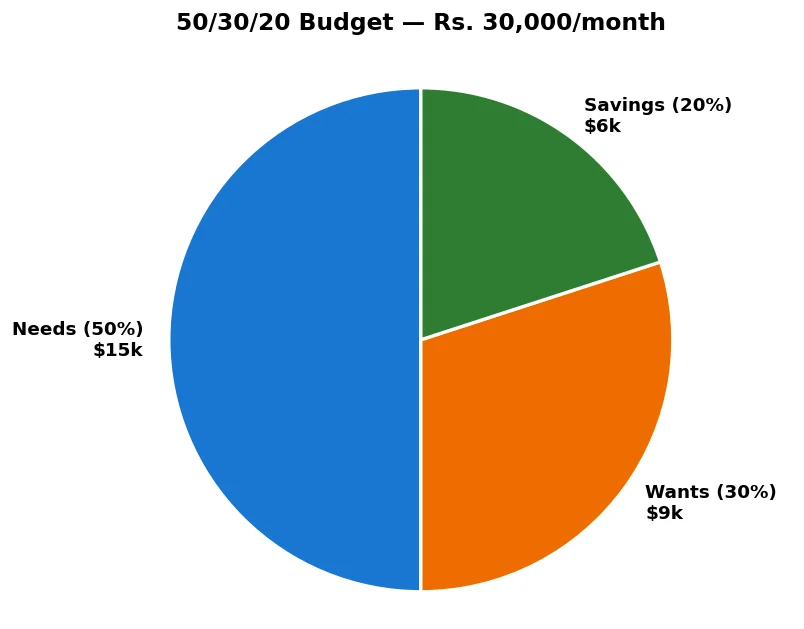
What does the actual monthly budget look like?
Here’s the line-by-line I’d hand a 24-year-old in their first $40K role.
- Rent + utilities: $950 (shared apartment outside expensive metros — Boston/SF/NYC requires roommates)
- Groceries: $300 (cook 5 nights/week; the USDA “low-cost food plan” estimates $313/month for one adult in 2026)
- Transportation: $300 (used car + gas + insurance, OR public transit pass in cities)
- Phone + internet: $70 (Mint Mobile or Visible + roommate-split home internet)
- Health insurance copays/meds: $80 (after employer plan deductions already taken pre-tax)
- Eating out + fun: $150
- Subscriptions: $30 (one streaming service, not five)
- Buffer / misc: $270
- Savings transfer: $500
Total: $2,650. That’s not a fantasy budget — it’s tight, but achievable in 80% of US metros. If you’re in NYC, SF, Boston, or Seattle, you’ll need a roommate or a side income.
Where should the $500 actually go?
Don’t park it in a Chase or Bank of America checking account paying 0.01%. As of January 2026, the average high-yield savings account (HYSA) at banks like Ally, Marcus, SoFi, and Discover pays 4.0–4.5% APY — and they’re FDIC-insured up to $250,000 per depositor per bank.
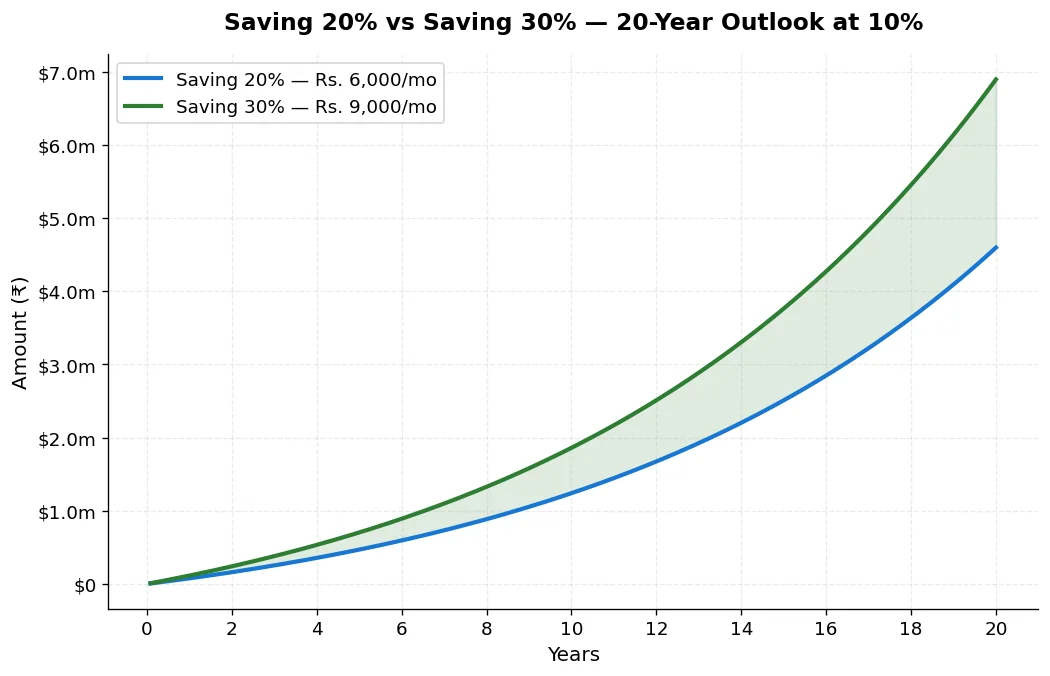
The math at 4.3% APY on $500/month deposits:
- Year 1: ~$6,138 (vs $6,000 deposited)
- Year 3: ~$19,200
- Year 5: ~$33,400
What if your employer offers a 401(k) match?
This is the single biggest mistake I see people my age skip. If your employer matches 50% on the first 6% you contribute, that’s an instant 50% return on those dollars — no investment will ever beat that.
On a $40K salary, contributing 6% ($2,400/year, ~$200/month from your paycheck before tax) gets you another $1,200/year from your employer free. That’s $100/month of pure additional saving that doesn’t even feel like a cut.
The 2026 401(k) employee contribution limit is $23,500 per IRS guidance. You’re nowhere near that at 6% of $40K — but capture the match first, every time.
What three habit changes free up the most cash?
- Cancel auto-renewing subscriptions you don’t use. The CFPB has flagged “subscription traps” as a growing consumer issue. Average household pays for 4–5 streaming services they don’t all watch. Cutting two saves ~$25/month.
- Cook lunch 3x/week. Average US restaurant lunch = $14. Brown-bagging it 3 days/week saves $40–50/week, or $160–200/month.
- Negotiate or switch your phone plan. Mint Mobile and Visible start at $15–25/month. If you’re paying $80/month at Verizon or AT&T, that’s $55/month back in your pocket.
Those three alone: ~$240/month freed up. Now $500 doesn’t feel impossible.
Common mistakes I’m watching out for during my CFP studies
- Saving without an emergency fund first. Before maxing investments, build a 3–6 month expense buffer in a HYSA. See my guide on how much Americans should save in an emergency fund.
- Carrying credit card debt while “saving.” Average US credit card APR in 2026 is ~22% per Federal Reserve G.19 data. Saving at 4% while paying 22% is mathematically a guaranteed loss.
- Not automating the transfer. Manual saving fails. Set up an automatic transfer for the day after payday hits.
How do you scale this as your salary grows?
The trap at $50K, $75K, $100K is lifestyle inflation. Every raise becomes a nicer apartment, a leased car, more delivery. Instead, the rule I’m trying to live by: save half of every raise, spend the rest.
If you bump from $40K to $50K, your net take-home rises by ~$650/month. Push $325 of that to savings (now $825/month total) and let lifestyle absorb the other $325. Five years of doing this and you’ve fundamentally changed your financial trajectory without ever feeling deprived.
FAQ
Q1. Is saving 20% of income realistic on $40K?
It’s aggressive but doable if rent stays under 30% of take-home and you avoid credit card debt. The Fed‘s data shows median Americans save 4–5%; 20% would put you in the top tier. Focus on capturing your 401(k) match first, then HYSA contributions.
Q2. Should I save or pay off credit card debt first?
Pay off credit card debt aggressively. Average APR is ~22%. No savings vehicle pays that — every $1 against credit card debt at 22% beats $1 saved at 4.3%. Keep a $1,000 starter emergency fund while you attack the debt.
Q3. What’s the best high-yield savings account for beginners?
I don’t recommend specific products, but check FDIC-insured online banks like Ally, Marcus by Goldman Sachs, SoFi, Discover, or Synchrony — they routinely beat 4% APY. Compare APYs on bankrate.com or nerdwallet.com.
Q4. Do I need a Roth IRA on a $40K salary?
Roth IRA can be powerful at lower incomes — you’re in the 12% federal bracket, so paying tax now and growing tax-free is favorable. 2026 contribution limit is $7,000 per IRS. But only after you’ve captured your 401(k) match and built a starter emergency fund.
Q5. How long until $500/month becomes serious money?
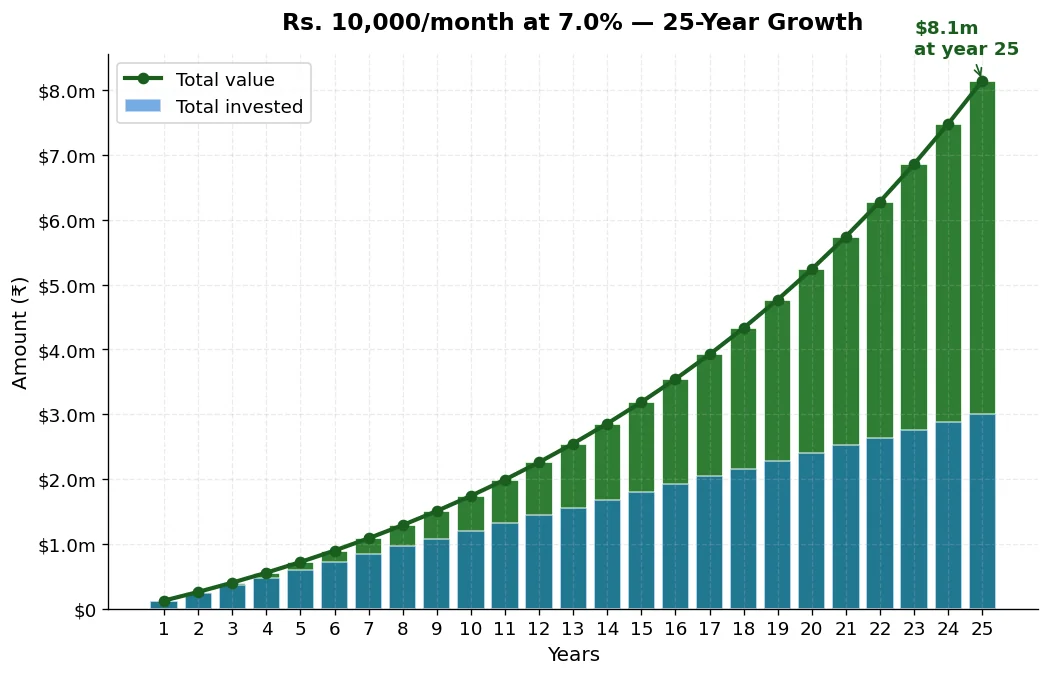
At 4.3% APY in a HYSA: ~$33,000 after 5 years. Invested at a long-term ~7% real return (S&P 500 historical average — not guaranteed), ~$36,000 after 5 years and ~$87,000 after 10. Time is the compounding lever; start now.
Related reading: monthly budget planner for US salaries, the 50/30/20 rule for US income, and how to cut monthly expenses by 30%.
